



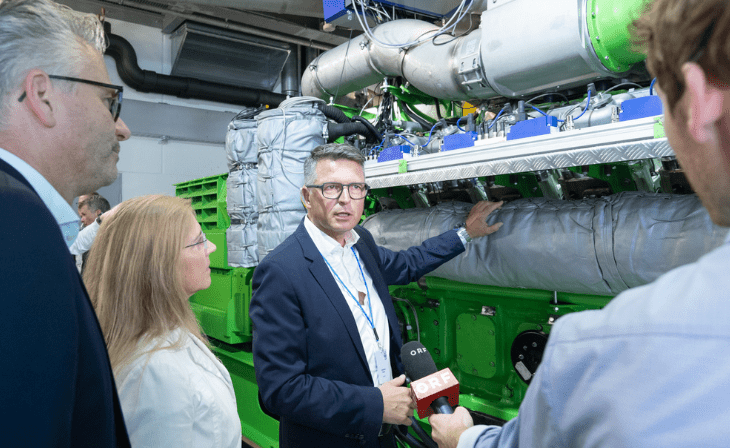
Global energy demand is growing rapidly. The increasing electrification of many sectors, and in particular the massive expansion of AI applications, require high-performance and, above all, climate-neutral energy systems. There is a need for resilient, scalable solutions that combine security of supply with climate targets.
Large engines will continue to play a central role in this context – just as they do in the shipping, rail and mining sectors. The challenge lies in utilising renewable energy sources whilst ensuring high performance and efficiency, as well as availability and flexibility. With the new Zero-Impact Demonstrator LEC ZID, the Large Engines Competence Centre (LEC) in the Innovation District Inffeld at Graz University of Technology has commissioned a research and validation platform and demonstrated the practical feasibility of climate-neutral operation of large engines.
[…]
“The energy transition is not only an environmental challenge, but also one relating to economic and technological policy. With research infrastructures such as the Zero-Impact Demonstrator, we are demonstrating that key technologies for climate-neutral and resilient energy systems are being developed, tested and put into practice here in Styria in collaboration with industry. In this way, we are ensuring that the Styrian economy can grow and that high-quality jobs in the region can be secured.” – Willibald Ehrenhöfer, Provincial Councillor for the Economy, Labour, Finance and Science.
What does ‘zero impact’ mean?
The term ‘zero impact’ is used when the application of a technology results in the release of no, or only negligible, quantities of air pollutants or climate-damaging substances, and thus has virtually no negative impact on the environment. A scientifically sound methodology has been developed at the LEC to define the emission levels relevant to large engines. This methodology takes into account not only direct emissions but also upstream effects throughout the energy supply chain, particularly in fuel production and transport. The methodology developed at the LEC generally classifies technologies as ‘zero-impact’ if their environmental impact is less than five per cent of that of an average, comparable reference technology.
LEC ZID: Hydrogen engine in the megawatt range
The LEC ZID combines a large hydrogen-powered engine with exhaust after-treatment to form a highly efficient integrated system. With an electrical output in the range of 2–3 MW, it matches the performance level of today’s natural gas engines. Compared with this defined reference, greenhouse gas emissions are reduced by 97 per cent. The remaining emissions arise from upstream effects during the production and transport of hydrogen, as well as from the technically unavoidable introduction of lubricating oil into the engine.
“With the Zero-Impact Demonstrator, we are demonstrating in real-world operation what large hydrogen-powered engines are already capable of today. It was important to us to prove their reliability and low-emission operation not just in the laboratory, but under real-world conditions.” – Nicole Wermuth, Scientific Director at the LEC and Professor of Large Engine Technology at Graz University of Technology
Technology for the energy transition
As the share of wind and solar energy increases, so does the need for flexible technologies that can supply energy when weather-dependent generation is insufficient.
“We developed the demonstrator as part of the COMET research programme LEC GETS because we are exploring how grid resilience and climate-neutral operation can be combined in practice. We see it as a concrete contribution towards bringing hydrogen-based large engines closer to practical application as a resilient backup solution.” – Thomas Jauk, CEO, LEC
Overall, the test infrastructure created enables the efficient further development of energy systems – for industrial sites as well as for data centres, critical infrastructure and decentralised, off-grid energy supply facilities.
Sustainable integration into the energy supply of the Inffeld Innovation District
The LEC ZID is fully integrated into Graz University of Technology’s energy system. During trial operation, electrical energy is fed into the local electricity grid. A heat recovery system also utilises the waste heat from the engine: up to 1.5 MW of thermal power can be fed into Graz University of Technology’s district heating network.
“With the Zero-Impact Demonstrator, the LEC is demonstrating how innovative energy generation and utilisation can effectively reduce the ecological footprint. This infrastructure, which is now coming into operation at the Inffeldgasse campus, is fully integrated into our energy system (heat and electricity). Graz University of Technology thus benefits not only from the energy itself, but also from its full integration into our Inffeld Innovation District. Here, the energy systems of the future are jointly developed, tested and demonstrated. The Zero-Impact Demonstrator also contributes to achieving our goal of a climate-neutral Graz University of Technology by 2030.” – Horst Bischof, Rector of Graz University of Technology.
[…]