



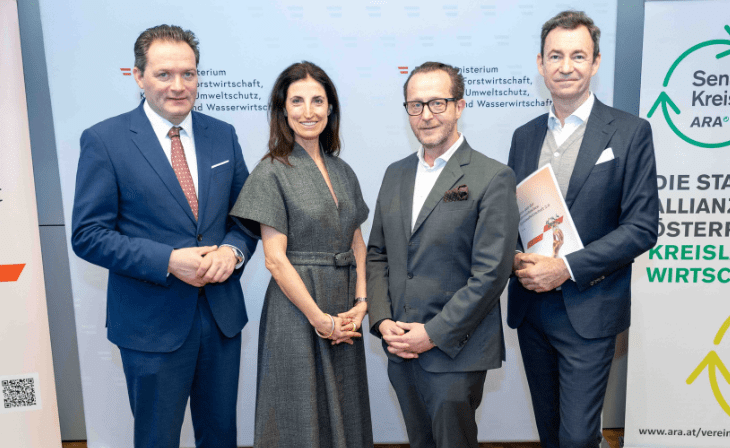
The combination of greater circularity, stable employment, and strong value creation underscores the significant economic importance of the circular economy in Austria. This is demonstrated by a recent study conducted by PwC in collaboration with the ARA Circular Economy Senate.
The circular economy must be at the heart of a sustainable economy. Above all, to conserve resources and strengthen environmental and climate protection. At the same time, it is a decisive factor for Europe and Austria in reducing dependence on imports and enhancing competitiveness. Numerous policy frameworks at the EU level—such as the Green Deal, the Clean Industrial Deal, the Circular Economy Act, and the new Packaging Regulation—aim to manage more raw materials in a more sustainable circular manner.
Environment Minister Norbert Totschnig: “Austria is one of the leading locations for environmental technology in the EU and has the potential to be a pioneer in sustainable raw materials policy. Our recycling rate has risen by 75% since 2012 to 15.2%, placing it above the EU average of 12.2%. Our goal is clear: By 2030, we want to increase it to 18% and further embed the circular economy in all sectors.”
Austria’s circular economy recently generated €16.6 billion in annual revenue
A recent study by PwC Austria*, conducted in collaboration with the Senate of the Circular Economy, highlights the current state of the circular economy in Austria: Approximately 13,800 companies with around 50,900 full-time equivalents generated €16.6 billion in revenue and €4.5 billion in gross value added. This combination of increased circularity, stable employment, and strong value creation makes a significant contribution to the Austrian economy.
“The domestic economy continues to face major economic challenges. The latest study by PwC and the ARA Association’s Circular Economy Senate shows that the circular economy remains resilient even during economic downturns. We are well on our way toward a circular future and view the implementation of the industrial strategy as a key measure for continuing to move forward. We need clear framework conditions and legal guidelines to ensure that investments in the circular economy are worthwhile in the long term,” said Harald Hauke, Spokesman of the Board of Altstoff Recycling Austria AG (ARA) and Coordinator of the Circular Economy Senate.
In 2023, 31 million tons of the total processed material in Austria came from recycling
As part of the study, PwC examined, among other things, material flows in Austria. In 2023, approximately 31 million tons—or 13.1%—of the total processed material in Austria came from recycling; in 2021, this figure was still 9.5%. In addition, interviews with representatives from key sectors such as batteries & vehicles, construction & buildings, plastics, waste management, and packaging yielded the following insights: Design and data determine success, as circular product design and transparent product data are key drivers of the circular economy. Meanwhile, free riders who do not adhere to requirements such as Extended Producer Responsibility hinder circular processes. They must be held accountable and contribute to the costs in the interest of fairness.
“The domestic economy continues to face major economic challenges. The current study by PwC and the Senate for the Circular Economy of the ARA Association shows that the circular economy remains resilient even in times of economic downturn. We are well on our way to a circular future and view the implementation of the industrial strategy as a key measure to further advance this. We need clear framework conditions and legal guidelines to ensure that investments in the circular economy are worthwhile in the long term,” said Harald Hauke, Spokesman of the Board of Altstoff Recycling Austria AG (ARA) and Coordinator of the Circular Economy Senate.
The Circular Economy as a Key Component of the Industrial Strategy
For the Senate for the Circular Economy, the clear commitment to the circular economy and recycling in the industrial strategy is crucial. This includes, in particular, the planned efforts to ensure raw material sovereignty through optimized use of Austrian and European resources, as well as the goal of increasing the use of sustainable raw materials. In addition, there are plans to link digital resource platforms—with a focus on the European trade of secondary raw materials and recyclates—to public procurement. This will increase demand for circular materials and secure investment and competitiveness. The ARA Association’s committee welcomes the fact that the business perspective has been taken into account and that solutions are being developed collaboratively.
“Secondary raw materials are increasingly becoming a strategic factor for industry. Production and use require even more incentives, which is why we strongly support the fact that the industrial strategy is aimed at this. This creates greater planning certainty for all stakeholders, which is essential for us in the Senate for the Circular Economy,” emphasizes Robert Nagele, BILLA Executive Board Member and Senator in the Senate for the Circular Economy.
PwC Study “The Current State of the Austrian Circular Economy,” March 2026, available for free download at: https://direkt.pwc.at/kreislaufwirtschaft-studie