



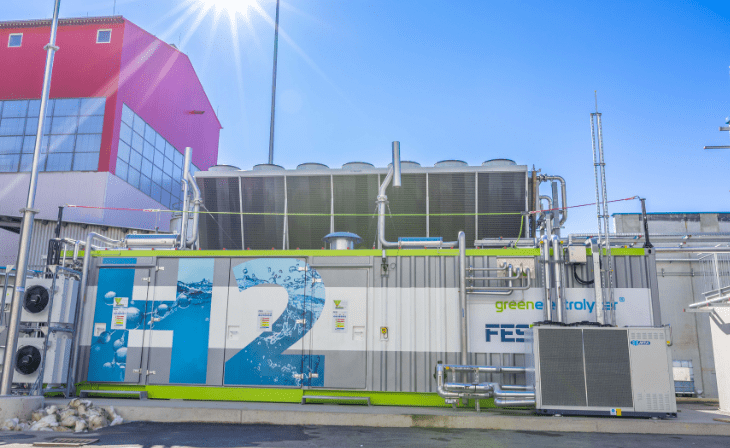
On 11 April, Kelag officially opened an electrolysis plant for the production of green hydrogen on the premises of Kärntner Restmüllverwertungs GmbH (KRV) in Arnoldstein. KRV is a joint venture between Kelag and Kärntner Entsorgungsvermittlungs GmbH.
The hydrogen plant was built as part of the ‘DeCarB – Decarbonising Carinthian Bus Transport’ project, an initiative of the Province of Carinthia, and represents a milestone for climate-friendly regional transport in Villach. The DeCarB project is being implemented in collaboration with the Province of Carinthia, Postbus, Gutmann and the Carinthian Transport Association.
At the opening ceremony, Sebastian Schuschnig, Regional Minister for Energy and Transport, emphasised that Arnoldstein had gone from the ground-breaking ceremony to actual hydrogen production within a year. “With this electrolysis plant, a vision is becoming reality. Carinthia is now producing green hydrogen from regional, renewable energy – and will use it to power Austria’s first fleet of hydrogen buses in regional transport. Today’s opening is a significant step in the implementation of Carinthia’s hydrogen strategy and the flagship ‘DeCarB’ project, and demonstrates the potential of a sustainable hydrogen economy for the local region,” said Schuschnig. Carinthia is thus among the pioneers in the decarbonisation of public transport and is further establishing itself as a key hub for innovation in hydrogen technology: “I would like to express my sincere thanks to our project partners for their foresight and courage in realising this project together. Producing emission-free hydrogen from renewable energy for 36 buses is, as of today, no longer just an idea, but a reality. Through this project, we will also gain important insights into the hydrogen future of our region,” explained the Regional Minister.
Green fuel from the region for Villach
With a capacity of up to three megawatts, the plant will produce zero-emission hydrogen from May 2026. Of this total available capacity, approximately one megawatt will be used directly to supply the new fleet of hydrogen buses, whilst the remaining two megawatts will be available to ensure security of supply and for future applications in the mobility and industrial sectors. Kelag has invested around 16 million euros in the construction of the plant and the associated infrastructure.
Two plants ensure reliable operation
Kelag board member Reinhard Draxler highlights the measures taken to ensure security of supply and emphasises that the plant system is designed with full redundancy: “Two parallel generation lines ensure continuous production and guarantee a reliable supply. I would like to extend my special thanks to all our partners and contributors who have made this high level of technical quality possible. The plant also symbolises our openness to technology and the use of regional renewable energy sources.”