



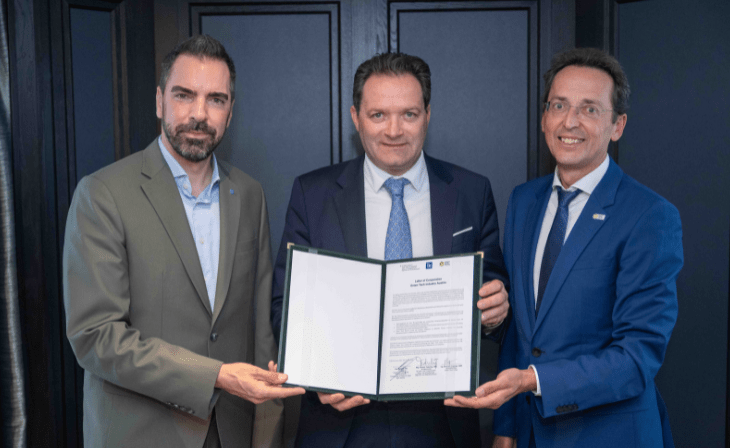
Through a joint memorandum of understanding, the Federal Ministry of Agriculture, Forestry, Climate and Environmental Protection, Regions and Water Management (BMLUK), the IV Green Tech Industry platform and Green Tech Valley are sending a strong signal for the future of the Austrian environmental and energy technology sector. The aim of this partnership is to further enhance the innovative strength, competitiveness and international visibility of domestic green-tech companies, thereby sustainably strengthening Austria as a business location.
Federal Minister Norbert Totschnig: “The green transition opens up great opportunities for Austria as a centre of business and innovation. By joining forces in this way, we are pooling our expertise and specifically strengthening those technologies that are crucial for competitiveness, value creation and sustainable growth in our country.”
Kari Ochsner, President of the Lower Austrian Chamber of Industry and Chair of the IV Green Tech Industry Platform: “Austria has built up industrial strength in energy and environmental technology that is in demand worldwide. Our companies develop ‘Made in Austria’ systems, components and solutions that save energy, use resources more efficiently, reduce imports of fossil fuels and strengthen our security of supply and resilience. But the competition is not standing still: other countries are investing heavily in their green-tech industries and vying for technological leadership. If Austria is to maintain and build on its strong position, it needs a clear framework for investment, innovation and production. This is precisely why the IV Green Tech Industry platform was established. Our aim is to raise the profile of this sector, bring its concerns together and put forward concrete proposals for industrial policy. After all, the best proposals for a successful green-tech hub come from the companies themselves.”
Bernhard Puttinger, Managing Director of Green Tech Valley: “Innovative pioneers, research and businesses have turned Austria – and Green Tech Valley in the south of the country – into a global technology hub for climate protection and the circular economy. In the EU-wide Eco-Innovation Index, Austria is even ranked in the top three as a ‘leader’. By joining forces in this way, we aim to further boost jobs and turnover for environmental protection ‘Made in Austria’.”
The declaration was signed during the BMLUK 2026 fireside chat, to which Federal Minister Norbert Totschnig – together with Kari Ochsner, President of the Lower Austrian Federation of Industry and Chair of the new IV platform Green Tech Industry, and Bernhard Puttinger, Managing Director of Green Tech Valley – had invited numerous managing directors of Austrian environmental and energy technology companies to Vienna.
The meeting focused on current developments in industrial and innovation policy, the role of environmental technology and the circular economy in the ‘Austria 2035 Industrial Strategy’, and the question of how Austria can further strengthen its position as a leading international green-tech hub. The environmental technology sector is already strong today: with over 3,300 companies and around 57,800 employees, the sector generated an annual turnover of more than 21 billion euros in 2023. Employment trends in the Austrian environmental technology sector also remain positive: in 2024, the number of employees rose by more than two per cent compared with the previous year – equivalent to an increase of over 900 additional green jobs. The export ratio stands at around 73 per cent – clear evidence of the international competitiveness of Austrian environmental technologies.
The new partnership between BMLUK, IV and Green Tech Valley now provides for a structured and regular exchange between policymakers, industry and environmental technology companies. Furthermore, initiatives are to be developed and further measures drawn up to strengthen the Austrian environmental and energy technology sector.
The circular economy as a strategic factor for the future
A key focus of the BMLUK fireside chat in 2026 was also the role of the circular economy as a driving force behind industrial transformation in Austria. The latest position paper presented by the ‘Task Force Circular Economy’ further underpins this strategic importance: it highlights the fundamental synergies between industrial strategy, circular economy strategy and bioeconomy strategy, and demonstrates how their interplay can contribute to strengthening the competitiveness, sustainability and resilience of Austria as a business location. Taken together, the three strategies unlock considerable potential, for example through higher resource productivity, the diversification of raw material sources and the development of new circular business models. The circularity rate, for instance, is regarded as a key indicator for monitoring the circular economy. Austria currently ranks seventh in the EU in terms of this figure. As part of the national circular economy strategy, the circularity rate is now set to be increased to 18 per cent by 2030 (currently 12.8 per cent), with the aim of positioning Austria among the top three EU Member States in this area by 2035.
Federal Minister Norbert Totschnig: “The circular economy is an active part of our economic development strategy: it strengthens our competitiveness, reduces our dependence on imports and opens up new opportunities for innovation and value creation in Austria. It is now crucial that we swiftly translate this potential into concrete action and establish the circular economy as a sustainable driving force behind Austria’s industrial transformation.”