



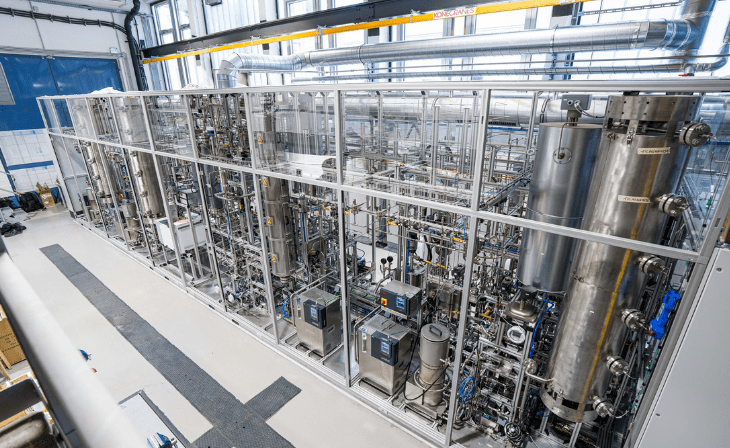
The Montanuniversität Leoben is conducting research, in cooperation with OMV, on the decarbonization of aviation: The Chair of Process Engineering for Industrial Environmental Protection has commissioned a research facility—the only one of its kind in Europe—to investigate and further develop various processes for the production of Sustainable Aviation Fuels (SAF). The new infrastructure was made possible by funding from the Federal Ministry for Innovation, Mobility, and Infrastructure, as well as financial support from OMV.
Europe’s Unique Research Facility in Leoben
The facility occupies an entire university building and offers exceptional flexibility: Various SAF manufacturing processes can be simulated under realistic conditions, compared, and evaluated in terms of efficiency, cost, and scalability in order to identify and further develop the most technically and economically promising production processes.
The experimental work is supported by state-of-the-art process simulation methods and machine learning models. This digital support accelerates development, minimizes risks during ramp-up, and lays the groundwork for efficiently scaling “Made in Austria” technologies to an industrial scale.
Prof. Markus Lehner, Head of the Chair of Process Engineering for Industrial Environmental Protection, emphasizes: “This facility is a major milestone in research toward sustainable, climate-neutral, and affordable mobility, including in aviation. It positions Austria and the research hub of Styria as one of the leading innovation centers in the field of civil aviation.”
Close Cooperation with OMV
The planning and construction of the facility were carried out in close cooperation with OMV. As a long-standing partner of the Montanuniversität Leoben, OMV actively contributes its technological expertise and innovative strength to this research facility. The partnership combines scientific excellence and industrial experience across the entire SAF value chain. OMV is consistently driving the development of sustainable aviation fuels (SAF), thereby making a key contribution to the decarbonization of aviation. SAF is a key component of OMV’s strategy to significantly reduce CO₂ emissions and shape a sustainable energy future.
Martijn van Koten, OMV Executive Vice President Fuels and Chemicals: “Our partnership with the Montanuniversität Leoben enables us to break new ground in fundamental fuel research. Innovation and technology form the foundation of our transformation into an integrated company for sustainable energy, fuels, and chemicals. Sustainable fuels play a central role in this: they already enable low-carbon mobility today and provide crucial support for our path to net-zero by 2050.”
Broad support from the federal government, state, and city
The initiative is supported by the federal government, the state, and the city, and strengthens Austria’s position as a hub for innovation in climate-friendly mobility.
“Sustainable aviation fuels are a crucial component in the decarbonization of modern aviation. As the federal government, we are providing targeted support for this technology through the SAF Roadmap. The Multi-Purpose Miniplant is one of numerous flagship initiatives through which we are systematically advancing the domestic mobility industry—a goal we have also set for ourselves as part of our industrial strategy. The new facility is unique in Europe in terms of its size and design and serves as an excellent example of our country’s innovative strength, as well as of what can be achieved when politics, science, and industry work together. This type of cooperation to solve key challenges is also supported by my ministry: We have funded this project through the FFG with approximately 1.2 million euros,” explains Minister of Innovation and Mobility Peter Hanke in his welcoming remarks to the organizers.
Willibald Ehrenhöfer, Provincial Minister for Economic Affairs and Research, emphasizes: “This research infrastructure at the Montanuniversität Leoben—unique in Europe—once again highlights what Styria stands for: excellence in research, strong cooperation between academia and industry, and a clear commitment to actively shaping the mobility of the future as a leading region for innovation and research. Sustainable aviation fuels, in particular, demonstrate just how crucial innovation is for climate protection and competitiveness. The close collaboration between the university, OMV, and the public sector strengthens the region’s position in the long term and puts Styria in pole position for the development of key technologies for climate-friendly mobility.”
Kurt Wallner, Mayor of Leoben: “With this new facility, the Montanuniversität once again demonstrates how research in Leoben is directly put into practice. Here, solutions are being developed for one of the greatest challenges of our time: climate-friendly mobility. This is a clear win for our city: We are strengthening our role as an internationally recognized center for technology and innovation and successfully bringing together academia, industry, and the public sector. This is exactly the kind of collaboration we need to advance the energy transition in aviation as well.”
SAF as a Key Technology for Climate-Neutral Aviation
Global air traffic accounts for approximately two percent of CO₂ emissions. Through the “ReFuelEU Aviation” initiative, the European Commission aims to make civil aviation climate-neutral by 2050. A key lever for achieving this is sustainable aviation fuel (SAF): synthetically produced kerosene that has the same chemical properties as fossil kerosene and can therefore be used in existing aircraft and infrastructure. SAF can reduce CO₂ emissions by more than 80% over its entire life cycle, thereby making a central contribution to the decarbonization of aviation.
The process chains for producing SAF are currently not yet fully mature in many areas: efficiencies are low, production volumes are limited, and costs are significantly higher than those of fossil kerosene. This is precisely where the new research infrastructure at the Montanuniversität Leoben comes in.
Further Information
Prof. Markus Lehner, Ph.D.
Chair of Process Engineering for Industrial Environmental Protection
Email: markus.lehner(at)unileoben.ac.at
Phone: 03842 402 5000
[Source: News, Montanuniversität Leoben, March 23, 2026]